
Criminal Court Records in Okmulgee County
A criminal court record is the case file the court clerk opens once charges are filed. In Okmulgee County the Court Clerk keeps that file for the District Court. The clerk logs every document in it. The record starts with the charging paper and grows with each hearing. It is not the same as the arrest or jail booking record. The arrest side stays with the sheriff and the jail. The court file is the part the judge and clerk maintain. Court Clerk Charly Frazier-Criner runs that office at 314 W. 7th St., Suite 305, in Okmulgee, and the desk line is 918-756-3042.
The District Court hears the criminal cases for the county. Felony cases carry the case code CF. Misdemeanor cases carry the code CM. A felony is the more serious class, and a misdemeanor is the lesser one. City ordinance violations are different. Those go to the Okmulgee Municipal Court, not the District Court. Some matters tied to the Muscogee (Creek) Nation may sit in tribal or federal court instead. For a wider look at every case type, the county court records overview covers civil, family, and probate files alongside criminal ones.
How to Search Okmulgee County Criminal Court Records
Two free state portals carry most Okmulgee County criminal case data. The Oklahoma State Courts Network, known as OSCN, publishes dockets for many courts. On Demand Court Records, known as ODCR, lists Okmulgee among its participating courts. Both let you search by name or case number at no charge. Image copies and some advanced tools cost extra.
- Open the docket search at OSCN or the court search at ODCR.
- Search by the defendant name as Last, First, or enter a known case number.
- Narrow the search by court, case type, and a filed-date range. Pick Criminal Felony or Criminal Misdemeanor when you know the class.
- Open the case to read the docket, the charges, and the disposition. Oklahoma case numbers follow a code-year-sequence pattern such as CF-2014-1.
- Request a certified copy from the Court Clerk if you need an official document for legal use.
State systems back up the local search. The Oklahoma DOC offender lookup shows people in state prison custody after sentencing. The Oklahoma sex offender registry lists registered offenders by area. Both pull from data that starts in a county criminal case.
Online portals do not hold everything. Older files, sealed cases, and non-digitized records may live only at the courthouse. For those, the Court Clerk counter handles in-person review and certified copies. City ordinance cases route to the Okmulgee Municipal Court, not the District Court. A tribal-jurisdiction matter may sit in the Muscogee (Creek) Nation court instead. When the result looks empty, the case may simply be in another venue.
Who Files Criminal Charges in Okmulgee County
The District Attorney files the charges. Police and the sheriff make arrests and build the case. Then the prosecutor decides what charges, if any, go to the court. District 25 covers Okmulgee and McIntosh Counties, and Carol Iski leads it. The Okmulgee office sits at 719 E. 8th, Suite B, and the phone is 918-756-0794. The charge record is the prosecutor's formal accusation, set down in writing and filed with the clerk.
Details on District 25 appear on the Oklahoma District Attorneys Council page for the office.
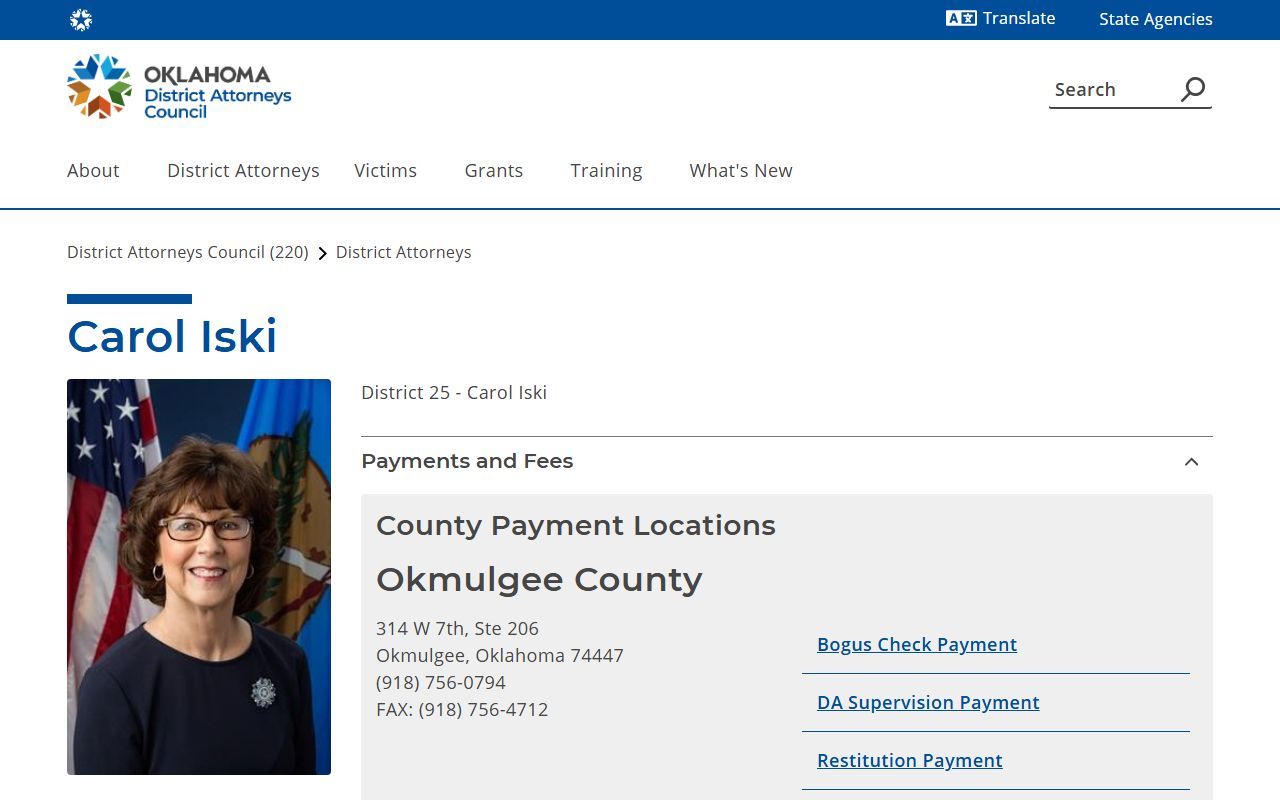
That listing confirms the prosecutor who brings most Okmulgee County criminal charges and where the office stands. A defendant who cannot afford a lawyer may get appointed counsel. The Oklahoma Indigent Defense System runs the public defense office for the area. Its Okmulgee office is at 205 S. Grand Ave., and the line is 918-752-0447.
The agency outlines its role on the OIDS Okmulgee coverage page.
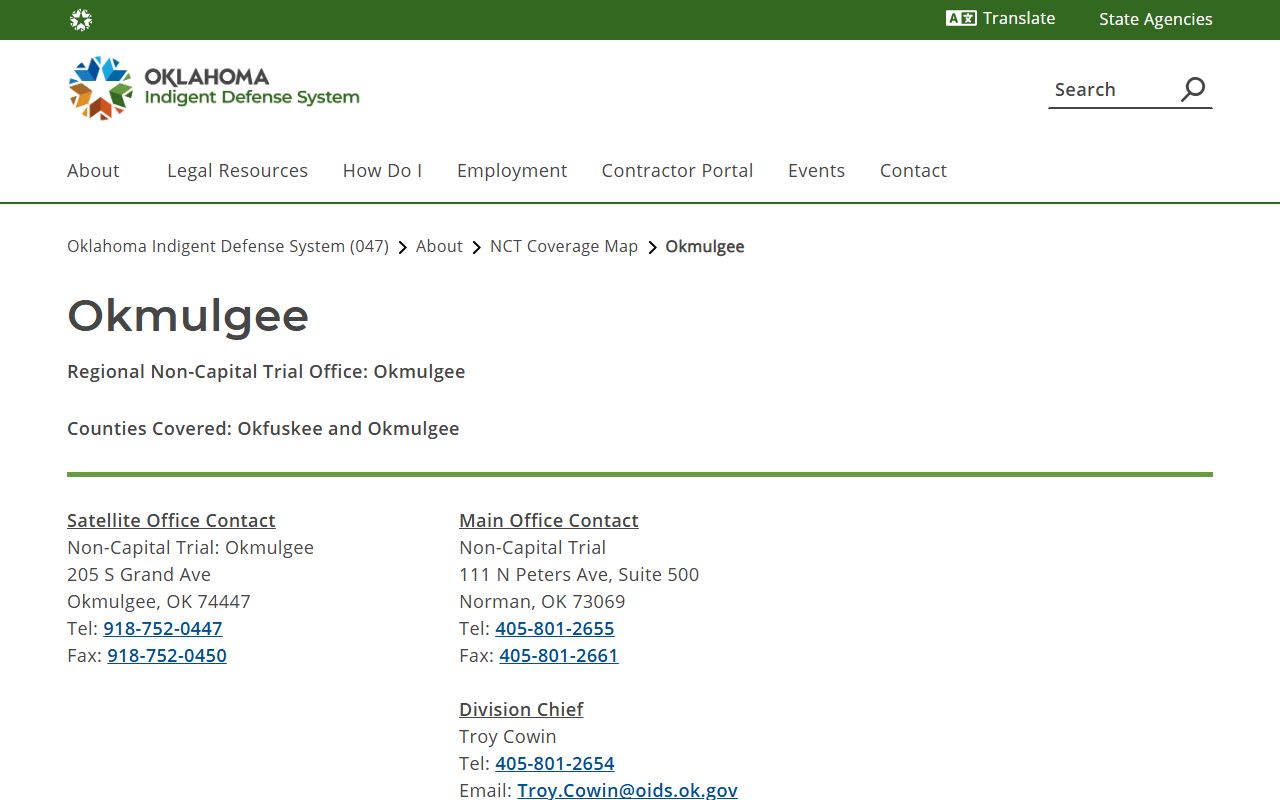
That page shows the public defense office that covers Okmulgee County and its neighbor. Both the prosecutor and the defense lawyer file documents that land in the case record. Their motions, briefs, and notices all become part of the public file once entered.
Stages of an Okmulgee County Criminal Case
A criminal case moves through set steps. Each step leaves a mark in the record. The docket lists them in order with dates. Reading that order helps you see where a case stands. A closed case shows every stage from start to finish.
Case flow: Charges Filed › Arraignment › Pretrial / Motions › Plea or Trial › Disposition › Sentencing
| Stage | What Happens |
|---|---|
| Arraignment | The defendant first appears, hears the charges, and enters a plea such as guilty or not guilty. |
| Pretrial / Motions | Lawyers file motions, exchange evidence, and argue legal points before trial. The judge sets hearing dates. |
| Plea or Trial | The case ends in a plea deal or goes to trial, where a judge or jury weighs the evidence and reaches a verdict. |
| Sentencing | After a guilty plea or verdict, the judge imposes the sentence, which can include jail, fines, probation, or costs. |
What an Okmulgee County Criminal Court Record Shows
The case file packs a lot of fields. Some help you find the case. Others tell you how it ended. The table below breaks down the core fields you will see in a public docket. A closer look at the charges themselves lives in the county arrest records and court charges guide.
| Field | What It Shows |
|---|---|
| Case Number | The unique code, such as CF-2014-1, with the case type, filing year, and sequence. |
| Defendant | The person charged, listed with the state of Oklahoma as the other party. |
| Charges | Each count, the offense named, and the statute cited where entered. |
| Plea | The formal answer, such as guilty, not guilty, or no contest. |
| Disposition | The final outcome of each charge, such as convicted, dismissed, or acquitted. |
| Sentence | The punishment set after a conviction, with jail time, fines, costs, or probation. |
Charges vs. Convictions
Being charged is not the same as being found guilty. A charge is an accusation. A conviction is a result. A criminal court record can show charges that were dropped, dismissed, or ended in an acquittal. Always read the disposition before you judge a record. A pending charge means nothing has been decided yet.
| Charge | Conviction | |
|---|---|---|
| Stage | Accusation | Verdict or plea |
| Burden of Proof | Probable cause | Beyond reasonable doubt |
| Public Record | Yes | Yes |
Reading Dispositions and Sentences
The disposition is the bottom line of a charge. It is the word that tells you how the count ended. Common entries include guilty, not guilty, and dismissed. A no contest plea, also called nolo, accepts the penalty without admitting guilt. A deferred sentence holds off on a conviction while the person meets set terms.
The sentence sits right beside the disposition. It spells out the penalty in plain terms. You may see a jail or prison term, a fine, court costs, and probation. Some sentences run at the same time, and some run one after the other. The docket also tracks payments, restitution to a victim, and any later changes the judge makes. If the wording is unclear, the Court Clerk can point you to the official order.
Note: A deferred sentence is not a conviction unless the person fails the set terms, so read the disposition closely before assuming guilt.
Sealed vs. Expunged Records
Oklahoma lets some people clear a criminal record. Sealing hides a record from ordinary public view. Expungement goes further and treats the record as if it never existed. The two are not the same, and the path to each differs. The state lists who may apply in 22 O.S. Section 18.
| Sealed | Expunged | |
|---|---|---|
| Visibility | Hidden from public | Destroyed / treated as never existed |
| Law Enforcement | Limited access | Very limited |
| Eligibility | Court-ordered, often after a deferred sentence is completed | Set by 22 O.S. Section 18 categories, such as a dismissal or acquittal |
The state agency that handles criminal history explains the rules on the OSBI expungement page.
That page confirms the OSBI cannot pre-approve eligibility and points back to the statute. To clear an Okmulgee record, a person files a petition, gives notice to the prosecuting agency, and attends any hearing. If a judge grants the order, it must be served on the Court Clerk, the arresting agency, and the OSBI.
Public Access to Okmulgee County Criminal Records
Oklahoma treats most court records as open. The Open Records Act presumes the public can inspect and copy government records. Online dockets are a convenience copy, not the official file. If the website and the clerk's record ever conflict, the clerk's file controls.
Key Statutes:
Oklahoma Statutes Title 51 § 24A.1 - the Open Records Act opens most government records for public inspection unless a law makes them confidential.
Court of Criminal Appeals Rule 2.6 - the OSCN internet search gives convenient access but does not replace the official court case file.
Background Check Considerations
A casual record lookup is not a legal background check. A real background check follows the Fair Credit Reporting Act. Employers and landlords must use a regulated agency for hiring or housing decisions. A free docket search is fine for personal study. It is not a substitute for a screened report. Court data can also lag the official file, so verify dates and outcomes with the clerk.
Important: This site is not a consumer reporting agency under the FCRA, and its records may not be used for employment, housing, credit, or other regulated screening.
Restricted Criminal Court Records in Okmulgee County
Some criminal records stay off the public portals. Juvenile cases are confidential under Oklahoma law. The Children and Juvenile Code keeps those files closed unless a statute allows access, under 10A O.S. Section 1-6-102. Sealed and expunged cases also drop out of ordinary search results. Mental health and adoption matters carry their own privacy rules.
Open warrants can be another gap. A bench warrant tied to a missed hearing may show in the docket, while a sealed warrant stays hidden until it is served. Tribal jurisdiction adds one more wrinkle. Because of McGirt and related rulings, some Okmulgee-area criminal matters belong in the Muscogee (Creek) Nation District Court or in federal court. A case missing from the state portal may simply live in another system.