
Okmulgee County Arrest Records and Court Charges
An arrest record is the record of the arrest itself. It notes who made the arrest, when the booking happened, and the offense the officer listed. In Okmulgee County the sheriff and jail hold that booking detail. After an arrest, the District Attorney reviews the case. The prosecutor then decides the formal charges and files them with the Court Clerk. Those filed charges become the court charge record. The booking offense and the filed charge can differ, since the prosecutor sets the final counts.
The two records sit in different places. The arrest and booking side stays with the jail, so the county inmate records page covers the roster and custody detail. The court charge record stays with the District Court, where the clerk tracks each count through the case. These court charges after arrest grow as the matter moves forward. For the full case file, the pleas, and the outcome, the county criminal court records page follows a charge to its end.
A booking record carries its own set of fields. The jail profile may list a booking number, a booking date, the arresting agency, and a primary offense. It can also show bond and a scheduled release date. That offense is what the officer logged at intake. It is not always the charge the prosecutor finally files. The two can match, or they can change once the case reaches the courthouse.
How to Find Okmulgee County Arrest Records and Charges
The court charge record shows up in the same portals that hold criminal cases. The Oklahoma State Courts Network, known as OSCN, publishes dockets for many courts. On Demand Court Records, known as ODCR, lists Okmulgee among its courts. Both are free to search. The booking detail behind an arrest lives in the jail roster instead.
- Open the court case search at OSCN or at ODCR.
- Search by the defendant name as Last, First, or enter a known case number.
- Open the case and read the charge list, with each count named and dated.
- Check each charge for its code, its level, and its current status.
State systems pick up where the case data ends. After sentencing, the Oklahoma DOC offender lookup shows people in state prison custody. Both the local docket and the state roll-up start from a single filed charge.
Not every charge lands in the District Court. City ordinance offenses go to the Okmulgee Municipal Court instead. Older or sealed files may never appear online. For those, the Court Clerk counter handles in-person review and certified copies. Some matters tied to the Muscogee (Creek) Nation may sit in tribal or federal court. A blank result does not always mean no charge exists.
Note: The online docket is a convenience copy, so the clerk's official file controls if the website and the court record ever disagree.
How Okmulgee County Charges Get Filed: Complaint, Information, and Indictment
Walk the path from the arrest forward. The arrest and booking come first. The charge record then begins when the prosecutor files a charging document. That paper is the formal accusation. Oklahoma uses three main forms, and the one used depends on the offense.
| Complaint | Information | Indictment | |
|---|---|---|---|
| Filed By | Officer / Prosecutor | Prosecutor | Grand Jury |
| Common For | Misdemeanors | Many felonies | Serious felonies |
| Starts | The case | The case | The case |
Most Okmulgee felony cases start with an information from the District Attorney. The complaint and information drive the bulk of filings. A grand jury indictment is the rarer route, used for the gravest offenses. Each document opens a case and gives it a number in the clerk's index.
The prosecutor needs probable cause to file. Probable cause means a fair reason to believe a crime occurred and that the named person is tied to it. On a felony, the court may hold a preliminary hearing to test that proof. If the judge finds enough, the case moves ahead toward trial. If not, the charge can be cut or dropped. The District Attorney for District 25 brings most state charges in the county, and that office sits in downtown Okmulgee.
Okmulgee County Charge Status and What It Means
Charges do not stay fixed. They shift as a case moves. A prosecutor may amend a count, reduce it, add one, or drop it. The docket logs each change with a date. Reading the status tells you where a charge stands today.
| Status | What It Means |
|---|---|
| Pending | The charge is filed and still open. No final outcome has been entered yet. |
| Amended / Reduced | The prosecutor changed the count, often to a lesser offense or a corrected statute. |
| Dismissed | The court dropped the charge. A dismissal with prejudice cannot be refiled; without prejudice it can. |
| Nolle Prosequi | The prosecutor chose not to pursue the charge, ending it without a conviction. |
Charges vs. Convictions
A charge is not a conviction. Being charged only means the state has made an accusation. A conviction comes later, through a plea or a verdict. A record can list charges that were dropped or that ended in an acquittal. Read the disposition before you draw any conclusion.
| Charge | Conviction | |
|---|---|---|
| Stage | Accusation | Verdict or plea |
| Burden of Proof | Probable cause | Beyond reasonable doubt |
| Public Record | Yes | Yes |
Sealed vs. Expunged Okmulgee County Records
Oklahoma lets some people clear a charge record. Sealing hides the record from public view. Expungement goes further and treats it as if it never existed. The state lists who may apply in 22 O.S. Section 18. A dismissed or acquitted charge is one common path to relief.
| Sealed | Expunged | |
|---|---|---|
| Visibility | Hidden from public | Destroyed / treated as never existed |
| Law Enforcement | Limited access | Very limited |
| Eligibility | Court-ordered, often after a deferred sentence is completed | Set by 22 O.S. Section 18 categories, such as a dismissal or acquittal |
The state agency that keeps criminal history explains the steps on its OSBI expungement page. It cannot pre-approve eligibility and points each applicant to the statute. A granted order must reach the Court Clerk, the arresting agency, and the OSBI before the record drops from public view.
Okmulgee County Charge Codes and Severity Levels
Each charge ties to a statute and a code. The case code signals the class of the charge. A felony case carries the code CF. A misdemeanor case carries the code CM. A felony is the more serious class, with stiffer penalties. A misdemeanor is the lesser class.
One arrest can produce several charges. A single booking may lead to two or three separate counts, each with its own code and status. The case number itself encodes the class, the year, and the sequence, in a pattern such as CF-2014-1. Reading the prefix is the fastest way to tell a felony file from a misdemeanor one. The statute cited beside each count names the exact offense.
The court search lists more than two criminal codes. Traffic counts carry TR, and declined traffic tickets get their own filter. Probable cause filings appear as a case type too. Each count in a case can end on its own terms. One charge may end in a conviction while another is dismissed. The disposition column tracks each count separately, so a case is rarely a single yes or no.
Statewide Charge and Criminal History Lookups
Local charges roll up into statewide records. After a person is sentenced to state prison, the Department of Corrections tracks the custody. Its lookup pulls from cases that began with a county charge.
The state offender tool is searchable by name at the Oklahoma DOC offender lookup.
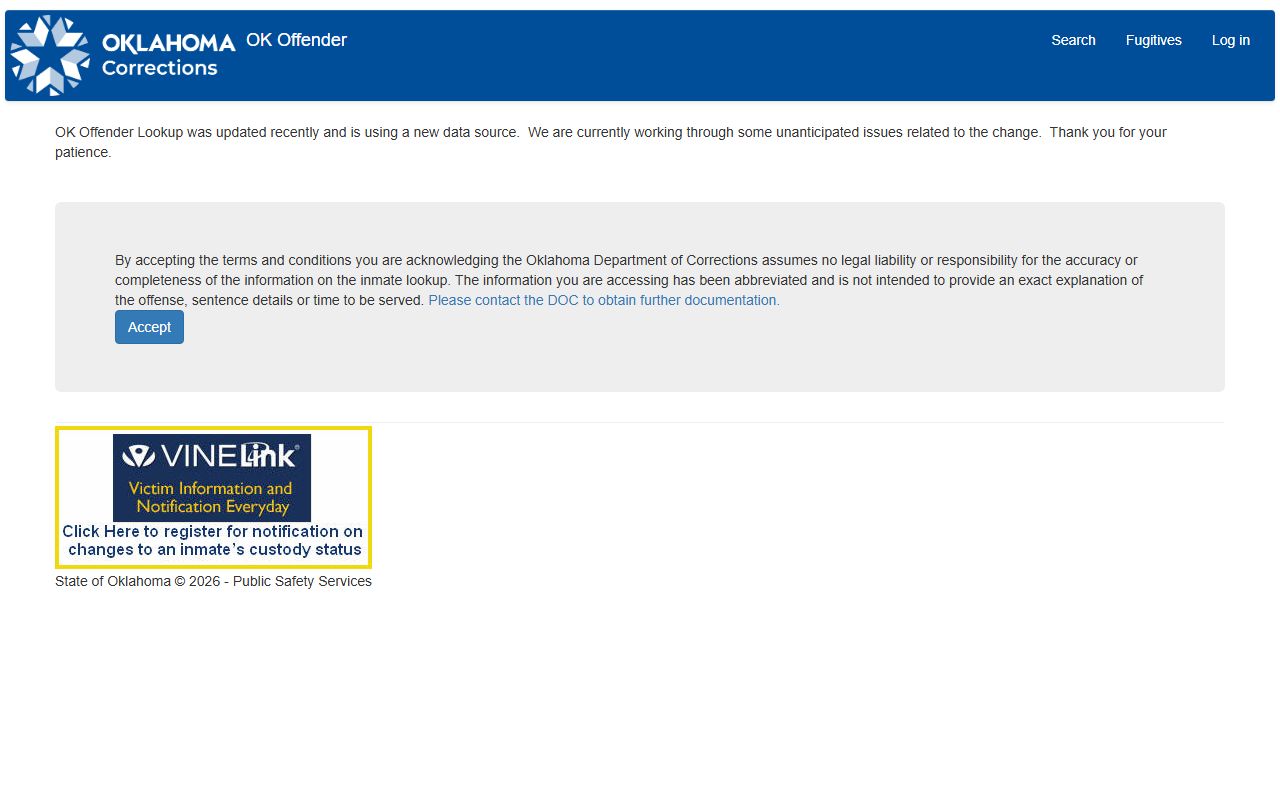
That page warns the data is abbreviated and does not explain a full sentence. A separate registry tracks people convicted of sex offenses. It is linked from the sheriff and city police pages and searched by area.
The registry is public at the Oklahoma sex offender registry.
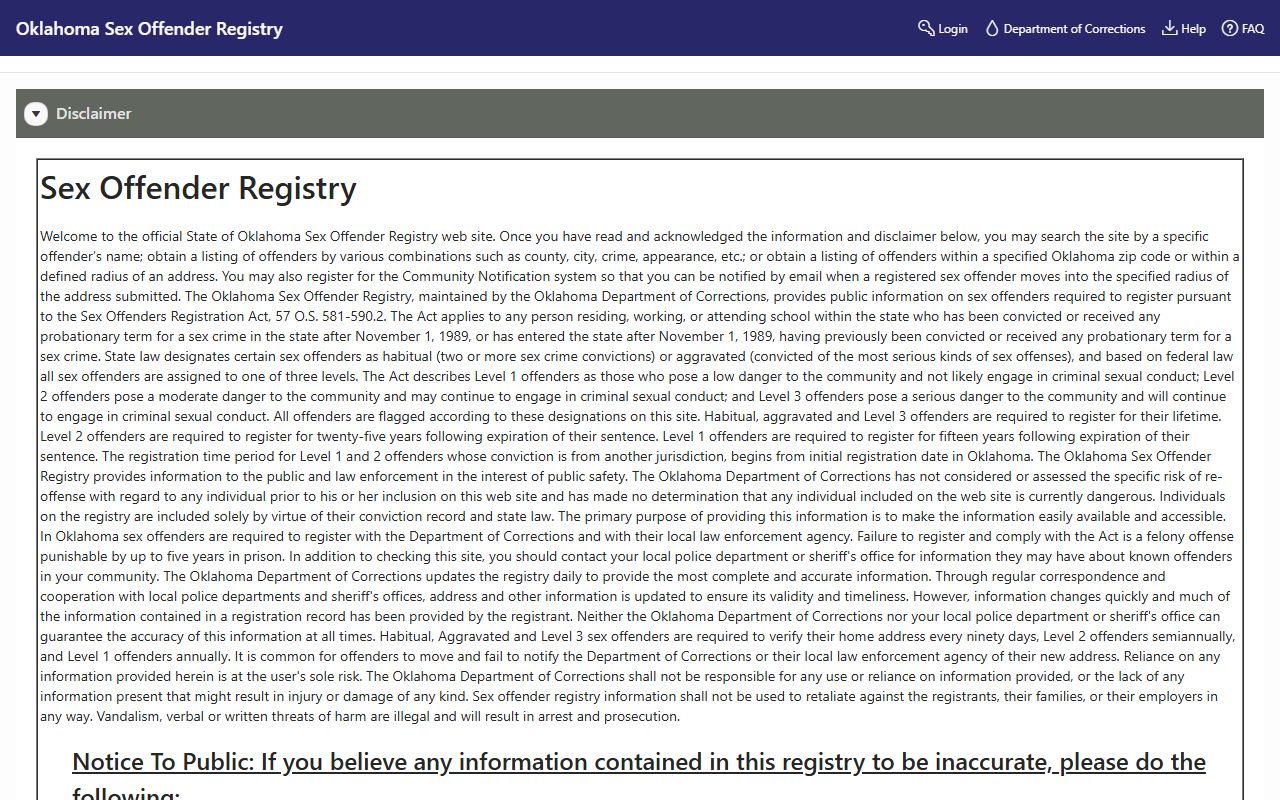
That registry shows how some charges carry duties that last well past a sentence. For a defendant who cannot afford a lawyer, the state runs a public defense system. It represents indigent defendants in most counties outside the two largest.
The agency describes its mission on the Oklahoma Indigent Defense System page.

That page shows the office that defends many Okmulgee charges once they are filed. The prosecutor and the defense lawyer both shape how a charge ends.
Background Check Considerations
A quick charge lookup is not a legal background check. A real background check follows the Fair Credit Reporting Act. Employers and landlords must use a regulated agency for their decisions. A free docket search is fine for personal use. It is not a screened report. Court data can lag the official file, so confirm any charge status with the clerk.
Important: This site is not a consumer reporting agency under the FCRA, and its records may not be used for employment, housing, credit, or other regulated screening.
Restricted Charge Records in Okmulgee County
Some charge records stay off the public portals. Juvenile charges are confidential under Oklahoma law, kept closed by 10A O.S. Section 1-6-102. Sealed and expunged charges drop out of ordinary search results. A dismissed charge may later be withheld once an order is processed. Ongoing investigations are not open while they are active.
Tribal jurisdiction can also explain a missing charge. Because of McGirt and related rulings, some Okmulgee-area charges belong in the Muscogee (Creek) Nation District Court or in federal court. A charge absent from the state portal may live in another system. When a record is closed, the Open Records Act still governs what an agency must release, under Oklahoma Statutes Title 51.
A declined charge is its own kind of gap. If the District Attorney reviews an arrest and files nothing, no court charge record opens. The booking may still appear in the jail data for a time. That mismatch is common right after an arrest, before the prosecutor acts. Checking both the roster and the court search gives the clearest picture of where a case stands.